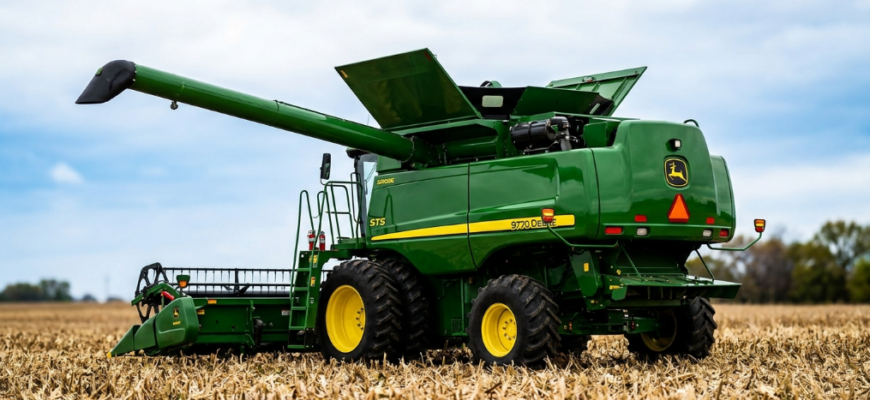
Is the John Deere 9770 STS Still Worth Buying?
This page is your buying decision system: it tells you what the 9770 STS is, what it really costs, what breaks most often, and how to inspect it—so you know whether you’re buying a future money‑maker or a liability.
What is the John Deere 9770 STS?
A mid‑2000s John Deere rotary‑rotor STS combine with a 9.0L PowerTech engine, StrongFrame design, and 360‑hp bullet‑rotor drivetrain, built for high‑capacity grain harvesting on medium‑to‑large farms.
Key specs (headline numbers)
- Engine: 9.0L John Deere PowerTech 6‑cylinder, 360 hp (rated), 385–393 hp in boost.
- Fuel: ~250 gallons (approx. 950 L).
- Grain tank: 300 bushels (10,600 L).
- Rotor: STS Single Tine Separation bullet rotor, 76 cm diameter, 312 cm length.
- Unloading: ~135 L/min (about 3.8 L/s), with 20‑ft auger.
Realistic 2026 price range (used)
- Core range (North America): $49,000 → $107,000+ for separator‑ready, field‑ready machines.
- Lower‑end: $49,000–$65,000 for higher‑hour or older‑year units.
- Mid‑range: $65,000–$90,000 for solid, well‑equipped 2006–2010 models.
- Premium / dealer‑loaded: $90,000–$110,000+ for 4×4, low‑hours, loaded‑up units.
Best use cases
- Medium‑to‑large grain farms upgrading from 9600‑style straw‑walkers.
- High‑acreage wheat / corn / soybean operations where daily throughput matters more than cutting‑edge tech.
- Owners who can self‑maintain or access a dealer familiar with 9.0L PowerTech and STS systems.
📊 Full Specifications (Scannable Table)
Keep this table as your spec anchor; in 2026, always verify exact numbers by serial number in the official operator manual (OMH229936 / OMHXE13769).
What “STS” Really Means (Beyond the Brochure)
STS = Single Tine Separation, John Deere’s rotary‑rotor system that uses a single row of tines instead of traditional rasp bars and concaves. The 9770 STS rotor is a “bullet‑type” rotor designed to move crop through with less power draw than older conventional‑style designs, which is why Deere advertises up to 20% lower power requirement for tough‑grain conditions.
Why STS Matters to You
- Throughput: The STS rotor can handle high‑moisture grain, tough stalks, and lodged crops while maintaining decent losses—so it’s well suited for large‑acreage grain operations that need speed and reliability.
- Grain quality: Lower fracture risk in beans and high‑moisture corn when settings are dialed correctly; the Dual‑Zone cleaning system also helps reduce tailings and breakage.
- Efficiency: The tine‑style separation reduces the load on the engine and drivetrain, so the 9.0L PowerTech doesn’t have to work as hard at high‑crop‑flow settings, easing fuel‑burn and driveline wear.
If you’re upgrading from a 9600‑style walker combine, the 9770 STS STS system is a major step up in capacity and efficiency, but it demands careful setup and maintenance to avoid grain loss and overload.
💰 Real Price Analysis (2026 Market Breakdown)
Current Price Range
MachineFinder and Machinery Pete data for used John Deere 9770 STS combines show a tight band once you filter out outliers, with most units falling between $49,000 and $107,000+. Examples:
- Lower‑end examples: $49,000–$65,000 for 2004–2007 models with 4,000–5,500 separator hours, missing or older options, often private‑sale‑only.
- Mid‑range examples: $65,000–$90,000 for 2006–2010 machines with 2,500–4,000 separator hours, 4×4, ContourMaster, variable‑speed feeder, and good cab features.
- Premium examples: $90,000–$110,000+ for 2009–2010, low‑hour, dealer‑loaded, 4×4, Duals, with recent maintenance recorded.
Farm‑dealer listings in Canada and Australia sometimes push higher, with some 2010–2011 9770 STS units advertised around $198,000–$203,500 AUD, reflecting strong local demand and limited supply.
What Drives the Price?
- Separator hours (2,500–4,500 typical): Separator‑hour range is the No. 1 price driver; machines under ~3,000 separator hours can command a premium, while 4,500+‑hour units usually trade closer to the bottom of the band unless heavily updated.
- Condition and maintenance history: Machines with documented service records, recent hydro‑drive or rotor work, and clean cabs move faster and support higher prices than neglected, high‑hour combines.
- Headers and options: 4×4, Duals, 35‑ft or 36‑ft platform, 12‑row corn head, ContourMaster, Touch‑Set Sieves, and ProDrive all push value upward, sometimes by $10,000–$20,000 depending on spec.
- Region and dealer vs private sale: Dealers often price 9770 STS units 10–20% above private‑sale “fair value,” but may include 90‑day warranties, financing, and some prep work; private‑sale units are cheaper but more “buyer‑beware.”
How to Judge “Fair Price vs Overpay”
Use this quick rule‑of‑thumb as a decision‑engine starting point:
- “Fair” private‑sale price: ~$15,000–$25,000 under comparable dealer‑loaded listings, assuming the machine is clean, well‑optioned, and has separator‑hours under 4,000.
- “Overpay” warning signs:
- More than $100,000 for a 2005–2007 9770 STS with 4,500+ separator hours and no known major‑component work.
- More than $80,000 for a 2004–2006 9770 STS without 4×4, big headers, or recent maintenance records.
Always factor in at least 10–15% of the purchase price for near‑term catch‑up maintenance (rotor bearings, feederhouse, belts, fluids, and potential 9.0L engine work), especially if hours are above 3,000–4,000.
⚖️ Should You Buy a John Deere 9770 STS? (Decision Engine)
Pros
- High capacity: With 360 hp, a 300‑bushel tank, and the STS rotor, the 9770 STS can keep pace with large‑acreage wheat and corn operations better than older 9600‑style walkers.
- Proven rotary system: The STS rotor and 9‑series hydraulic/hydro‑drive layout are well‑understood in the dealer ecosystem; parts and service support are strong in North America and many export‑market regions.
- Strong resale value for clean examples: A 9770 STS with low‑to‑mid‑range separator hours, 4×4, and a good cab still trades actively and can hold value better than many mid‑2010s models with emissions and electronics complexity.
Cons
- Expensive repairs: The 9.0L PowerTech engine is known for head‑gasket, liner, and water‑pump failures, with overhauls often running $15,000–$20,000+ CAD / USD when done correctly. Rotor‑bearing and hydro‑drive work also adds thousands when deferred.
- Electronics complexity: Multiple sensors, turbo actuators, moisture sensors, and ControlCenter‑style monitors can create “invisible” downtime if wiring or modules fail.
- Fuel consumption: A 300‑bushel STS‑rotor combine with 360 hp burns more fuel per acre than a well‑set‑up 9600‑style walker, especially in high‑crop‑flow or high‑moisture conditions.
When It Makes Sense (and When It Doesn’t)
Buy a 9770 STS if:
- You run 1,000+ acres of grain per year and need a primary machine that won’t buckle in tough wheat or corn.
- You have access to a dealer or mechanic familiar with 9‑series STS systems and can budget for a 9.0L engine or rotor‑bearing overhaul.
- You are upgrading from a 9600 or 9560‑style combine and want more capacity without jumping into S‑series or later‑emissions complexity.
Avoid or be very cautious if:
- You’re on a tight repair budget and unwilling to risk a six‑figure machine.
- You expect new‑machine‑level reliability without documented maintenance; the 9770 STS is a 20‑year‑old platform, and many units are now at or beyond major‑wear‑part life.
- You need cutting‑edge precision‑ag capabilities; the 9770 STS can be mapped, but its tech stack is dated compared with S‑series and newer models.
Buying Checklist: “Inspect Before You Buy” (Finishing 5.2–5.5)
Feederhouse, Auger, and Grain Tank
- Feederhouse lining and chain wear: Look for worn feederhouse floor strips, stretched or elongated conveyor chains, and worn feederhouse drive sheaves; excessive wear forces the rotor to work harder and increases grain loss.
- Feederhouse reverser and two‑speed gearcase: Raise the feederhouse, inspect for metal shavings in oil, and check that the reverser gearcase and two‑speed separator drive have clean oil at the proper level per the operator manual.
- Grain elevator and unloading auger: Inspect the grain elevator auger and drive belt for wear, and test the 20‑ft unloading auger for smooth operation and consistent speed across the variable‑speed range.
- Grain‑tank floor and pan: Open inspection plates and look for cracks, liner wear, and pitting; heavy wear on the tank bottom is a common 9770 STS wear point after 3,000–4,000 separator hours.
Cleaning System & Sieves
- Upper and lower sieves: Lift the sieve covers and inspect the front and rear chaffer and lower sieves for cracks, broken or missing bars, and worn‑through edges; cracked or worn‑out sieves will cost hundreds of dollars in parts and labor to replace.
- Dual‑Zone cleaning settings: Check that the Dual‑Zone Cleaning System levers, motors, and linkage move freely and that sieve settings can be adjusted from the cab; seized or sloppy linkage indicates upcoming repair bills.
- Fan and drive belts: Inspect the cleaning fan housing and drive belts for cracks, glazing, or hour‑glass‑style wear, and verify that the fan spins smoothly without vibration when the machine is running.
Rotor‑Related & Driveline Wear
- Rotor‑belt and sheave gap: Verify the rotor drive belt is not hour‑glassed or glazed, and check that the sheave‑gap setting matches the operator manual; a poorly adjusted rotor drive can create noticeable vibration and overload the hydro system.
- Rotor balance and bearings: Ask the seller to run the rotor at high speed while the feederhouse is raised; any rumbling, buzzing, or vibration that changes with rotor speed points to unbalanced tines, bad drive belts, or worn rotor bearings.
- Final drives and hydrostatic system: Check for leaks at the final drive seals, verify oil levels with the dipsticks on each gearbox, and listen for whining or knocking in the hydrostatic drive and transmission.
Cab, Electronics, and Sensors
- Engine hours and 9.0L 6090 service history: Confirm separator and engine hours, and ask for any 9.0L 6090 PowerTech repair history; head‑gasket, liner, and water‑pump failures are known issues on early‑build 9.0L engines, with overhauls often running $15,000–$20,000+ CAD/USD.
- Hydraulic and hydro‑oil health: Check the hydraulic and hydrostatic reservoir oil for level, cleanliness, and contamination; dirty or milky oil signals seals or cooler failures that can ruin the hydro drive if ignored.
- Controllers, sensors, and warning codes: Power up the machine, clear or record any stored trouble codes, and test key sensors (mass flow, moisture, turbo actuator, feederhouse‑speed, and header‑tilt). These small electronics can idle a combine in the field if not maintained.
- Cab and comfort systems: Inspect the cab mount, seals, AC, heater, and seat; a clean, tight cab often correlates with better overall care, and many owners keep 9770 STS machines in service on second‑shift or backup‑duty roles.
Use this checklist as your price‑negotiation backup: if the rotor bearings, sieves, or 9.0L engine need imminent work, deduct a realistic repair cost from the asking price and treat what’s left as your real purchase value.
🔧 Common Problems & Typical Repair Costs
What Breaks Most Often
- 9.0L 6090 engine (head‑gasket, liners, water pump): Liner‑seal issues and head‑gasket failures have been documented on North‑American 9770 STS engines, with some units failing as early as 1,500–2,000 engine hours and many seen around 2,000–2,500.
- Feederhouse and conveyor‑chain wear: Aggressive operators and high‑hour usage rapidly wear feederhouse liners and chains, forcing rebuilds that can run $1,000–$2,000+ in parts and labor.
- Rotor‑drive belts and bearings: Slipping, glazed, or hour‑glassed belts and worn rotor‑drive bearings generate vibration and premature rotor‑shaft wear, with complete belt and bearing jobs commonly costing $1,500–$3,000+ depending on labor.
- Hydrostatic/hydro‑drive leaks and noise: The 9770 STS uses a hydrostatic drive and hydrostatic‑type geartrain, so seal and pump failures can develop over time, with major repairs ranging $3,000–$8,000+ if the final drive or hydro unit needs work.
- Cab electronics and sensors: Turbo‑actuator faults, moisture‑sensor failures, and feederhouse‑speed electronic‑drive issues show up in owner reports, and while parts are often modest cost, diagnosis can idle a machine for a day without a dealer familiar with TM101819‑style diagnostics.
Downtime Risk and Budgeting
For a typical 2004–2008 9770 STS with 3,000–4,500 separator hours, many owners budget:
- Immediate catch‑up maintenance: $5,000–$10,000 USD for belts, chains, fluids, sieves, and basic 9.0L engine‑related items (hoses, belts, gaskets, minor leaks).
- Major 9.0L engine overhaul (if deferred): $15,000–$20,000+ if the head‑gasket, liners, and water pump all need replacement at the same time.
- Hydro‑drive / rotor‑drive overhauls (as needed): $3,000–$8,000+ depending on whether the repair is belts and bearings or a full hydro unit rebuild.
Treat any 9770 STS purchase as a 3–5 year investment plan, not a one‑time capital event; if you can’t budget for at least one major 9.0L or rotor/hydro event, the machine is too risky for a primary‑harvest role.
🆚 9770 STS vs 9600 vs S670 Comparison
Side‑by‑Side Snapshot
| Feature | John Deere 9600 | John Deere 9770 STS | Case IH S670 |
|---|---|---|---|
| Platform type | Conventional straw‑walker | STS rotary‑rotor | Rotary (Axial‑Flow) |
| Year range | 1989–1997 | mid‑2000s (approx. 2004–2010) | 2000s–2010s rotary platform |
| Engine power | ~250–260 hp | 360 hp (rated), 385–393 hp boosted | 350–400 hp class on later S600‑series |
| Grain tank | 240 bushels | 300 bushels | 250–300 bushels depending on spec |
| Throughput style | Walker‑style, proven reliability, lower‑tech | STS single‑tine rotor, high‑throughput, more power‑efficient | High‑capacity, twin‑rotor, very high‑throughput |
| Maintenance complexity | Low‑to‑medium: simple mechanics, easy repairs | Medium‑high: 9.0L engine complexity, hydro‑drive, electronics | Medium‑high: rotary‑specific rotor and cleaning systems |
| Fuel efficiency | Moderate, good for its era | Med‑high: 360 hp and 300‑bu tank push fuel use | Typically high‑fuel, high‑throughput pattern |
| Tech age / electronics | 1990s‑style, very simple | 2000s‑style; cab, sensors, and multiple controllers | 2000s–2010s, modern cab and electronics |
| Typical 2026 price (used, North America) | $7,500–$30,000 USD | $49,000–$110,000+ USD | $40,000–$100,000+ USD (varies by year and options) |
| Best‑fit upgrade | From 8820–9400‑style walkers, budget‑focused | From 9600‑style walkers, high‑acreage wheat/corn | From older rotary or high‑acreage, tech‑savvy buyer |
Data sources: Deere spec sheets, Machinery Pete listings, 9.0L engine case studies, and owner‑reported 9600/9770 STS values.
ROI and “Who Should Upgrade To What?”
- Upgrade to a 9770 STS from a 9600: Best for farms that want significantly more throughput and modern‑style rotary efficiency without jumping into S‑series complexity and pricing; 9770 STS offers 25% more tank space and stronger capacity, but at roughly 3–4× the 9600 price.
- 9770 STS vs S670: The S670 delivers higher daily throughput and more modern cab features, but often at a higher capital cost and with more complex electronics and maintenance; for operators who value proven Deere STS architecture and dealer support, the 9770 STS is a strong alternative.
- 9600 vs 9770 STS on ROI: The 9600 wins on low‑hour repair‑cost profile and simplicity; the 9770 STS wins on daily capacity and efficiency for 1,000+‑acre operators willing to manage 9.0L‑engine risk and hydro‑drive upkeep.
📘 Manuals: Which One You Need BEFORE Buying
Types of 9770 STS Manuals
- Operator’s Manual (OMH229936 / OMHXE13769): Covers daily operation, control functions, lubrication schedules, filter capacities, and basic adjustments for the 9670 STS and 9770 STS. This is the one you must read before purchase to understand normal operating ranges, safety interlocks, and recommended maintenance intervals.
- Service/Shop Manual (TM101819‑style): Detailed factory‑style service information for 9570/9670/9770/9870 STS combines, including engine removal, hydro‑drive disassembly, rotor‑bearing work, and hydraulic troubleshooting. This is the “deep‑dive” manual for any major repair.
- Diagnostic Manual (TM101819‑diagnostic): Focuses on fault codes, controller tests, and sensor diagnostics, essential for owners who want to chase down electrical and electronic gremlins without paying dealer diagnosis time every time the cab throws a code.
- Parts Catalog (e.g., 9770 STS‑specific catalog): Pictorial parts index for every assembly, so you can price‑out complete rotor‑bearing kits, feederhouse‑chain rebuilds, and header‑specific parts before committing to a machine.
Why Manuals Matter Before Inspection
Read the operator manual before you even walk up to the machine so you can:
- Judge whether the seller’s “it’s been serviced” story matches Deere‑recommended intervals for filters, oil, and hydraulic fluid changes.
- Understand normal operating temperatures, pressures, and warning‑light behavior, so you can spot tell‑tale 9.0L cooling‑and‑oil‑leak patterns early.
- Identify exactly which components (e.g., right‑side rotor‑drive bearing, final drive, or feederhouse reverser) are likely to need work on high‑hour machines, turning vague “it’s worn” into concrete repair‑cost estimates.
If the seller does not have any of these manuals, budget extra for purchasing them digitally before closing the deal; they are often the difference between smooth ownership and unexpected‑six‑figure repair surprises.
🎯 Who Should Buy a John Deere 9770 STS?
Target Farm Profiles
- Medium‑large grain farms (1,000–3,000+ acres): Farms harvesting wheat, corn, and soybeans where daily capacity and 300‑bushel unload speed matter more than cutting‑edge emissions tech.
- Upgraders from 9600‑style straw‑walkers: Operators who want to move from 240‑bushel walkers to 300‑bushel STS rotary throughput without jumping into S‑series electronics and pricing.
- High‑acreage, low‑tech operators: Those who want strong, proven Deere drivetrain reliability and dealer support, and are comfortable budgeting for 9.0L engine and rotor‑drive work rather than paying for a new‑series machine with all‑new electronics and emissions complexity.
When You Should Avoid or Pause
- Tight‑repair‑budget operators: If you can’t tolerate a possible 9.0L‑engine overhaul or major hydro‑drive repair, the 9770 STS is too expensive to own as a primary machine.
- Tech‑only precision‑ag buyers: If you need deep‑data integration, autosteer‑ready control, and latest‑generation yield‑mapping, an S‑series or newer platform is a better fit.
- First‑combine buyers with no mechanic support: A 9770 STS is a complex, high‑power machine; if you don’t have dealer or in‑house mechanical expertise, a later‑model but smaller rotary or even a well‑maintained 9600‑style walker may be safer.
❓ FAQ
How much is a 9770 STS?
Most 2004–2010 John Deere 9770 STS combines change hands in the $49,000–$110,000+ range in North America, with clean, low‑to‑mid‑hour 4×4 machines with full headers often at the upper end of that band. Private‑sale prices are typically 10–20% below dealer listings, but buyers should account for an extra 5–10% of purchase price for immediate maintenance and repairs.
What does “STS” mean on the 9770?
“STS” stands for Single Tine Separation, John Deere’s rotary‑rotor threshing system that uses a single row of tines instead of traditional rasp bars and concaves. The STS rotor is designed to move crop through with less power draw, which improves throughput and reduces engine load in tough‑grain conditions.
How many horsepower does a 9770 STS have?
The John Deere 9770 STS is powered by a 9.0L John Deere PowerTech 6‑cylinder engine, with approximately 360 hp rated and 385–398 hp available in boost, depending on year and calibration. This places it in the upper‑mid power band for mid‑2000s high‑capacity combines.
Is the 9770 STS reliable?
When properly maintained, the 9770 STS is considered a reliable, high‑throughput workhorse for large‑acreage grain operations. However, the 9.0L 6090 PowerTech engine has documented head‑gasket, liner, and water‑pump issues on some North‑American builds, and owners frequently plan for future overhauls. Separately, the STS rotor, hydro‑drive, and hydraulics are robust but not immune to wear, so reliability depends heavily on maintenance history and hours.
Is the 9770 STS fuel‑hungry?
Compared with older 9600‑style walkers, the 9770 STS usually burns more fuel per acre, especially at high‑throughput settings, because of the 360‑hp 9.0L engine and 300‑bushel grain‑tank system pushing larger volumes through the field. Fuel use is highly crop‑ and condition‑dependent, but many operators expect higher fuel costs than a 9600 in exchange for the extra capacity and time savings in harvest windows.
What are the most common 9770 STS problems?
- 9.0L 6090 engine issues: Head‑gasket, liner leakage, and water‑pump failures are well‑documented on early‑build 9.0L engines; some units fail as early as 1,500–2,000 hours, while many others last much longer.
- Rotor‑drive belts and bearings: Worn, glazed, or hour‑glassed belts and failing rotor‑drive bearings create vibration and can lead to costly shaft and bearing work.
- Hydro‑drive and hydraulic leaks: Hydrostatic drive seals, final‑drive seals, and hoses are common leak points; dirty or milky oil signals pump or cooler issues that can snowball into major repairs.
- Cab electronics and sensors: Turbo‑actuator faults, moisture‑sensor failures, signal‑drive errors, and ControlCenter‑style controller gremlins crop up in owner reports, though they are often low‑cost but time‑consuming to chase down.
Owners who manage these issues with planned maintenance and budgeting usually keep 9770 STS machines in service for years, but the 9.0L engine remains the single biggest risk factor.
How many engine or separator hours is “good” on a 9770 STS?
There is no universal “safe” hour number, but many operators treat:
- Under 2,500 separator hours as a strong sign of a relatively fresh machine, especially if the 9.0L engine is also below 2,000–2,500 hours.
- 2,500–4,000 separator hours as the “working range” where you expect to budget for feederhouse, chain, and belt work, plus some hydro/rotor bearing refresh.
- Over 4,000 separator hours as a signal that major components (engine, rotor bearings, final drive, or hydro‑drive) may already be overdue or will be soon, and price should reflect that risk.
Always verify hours with maintenance records and consider a 9.0L‑engine overhaul contingency if the machine is in the 2,000–2,500‑hour bracket with no documented work.
What’s the best 9770 STS buying strategy?
The smart 9770 STS buying strategy is to:
- Target 2006–2009 units with under 3,500 separator hours, 9.0L engines that have been serviced on time, and clean, straight‑tins with 4×4 and a 30–36‑ft header that matches your operation.
- Use the full buying checklist to spot hidden wear (rotor bearings, hydro‑drive, feederhouse liners, sieves, and 9.0L cooling/oil‑system leaks) and price accordingly.
- Budget 10–15% of the purchase price for immediate catch‑up maintenance and $15,000–$20,000+ for a potential 9.0L engine overhaul if the machine is in the 2,000+‑hour range.
Done right, the 9770 STS can be a high‑throughput, high‑reliability primary machine; done wrong, it becomes an expensive repair liability. The difference is discipline at inspection and honest pricing.
🚀 Final Thoughts
- Compare current 9770 STS listings: Use dealer and auction sites to cross‑check asking price against separator hours, condition, and options, then apply your own inspection checklist.
- Check real prices before you fall in love with a machine: A clean 9770 STS with known‑low hours and 4×4 rarely sells cheap; if the price seems too good, assume there’s catch‑up maintenance in the fine print.
- Download the operator and diagnostic manuals before inspection: The 9770 STS operator manual (OMH229936 / OMHXE13769) and TM101819 diagnostic manual let you understand Deere‑recommended specs, sensor behavior, and repair steps, turning a casual walk‑around into a proper technical evaluation.
With this page as your guide, you’re no longer just buying a 9770 STS—you’re buying a clear‑eyed harvest‑capacity decision backed by data, manuals, and a proven checklist.