Elevate Your Woodturning with a Steady Rest
For any serious woodturner, vibration is the invisible enemy. A long, elegant spindle starts to whip, a large bowl blank shudders under the tool, or a thin-walled vessel chatters so violently it feels like it might disintegrate. These moments ruin promising pieces, compromise safety, and cap the scale and precision of your work.
A well-designed Wood Lathe Steady Rest changes that. Mounted on the lathe bed between headstock and tailstock, it acts like a third bearing, cradling the workpiece and draining away vibration. With the global wood lathe market expected to grow from about USD 0.22 billion in 2024 to roughly USD 0.3 billion by 2033 and the dedicated lathe steady rests market forecast to climb from USD 1.4 billion in 2023 to about USD 2.3 billion by 2032, these supports are no longer niche gadgets but mainstream precision tools.
This 2026 guide explains how steady rests work, which features matter, and which models stand out for spindles, bowls, vessels, and mini lathes. It also naturally incorporates critical buying keywords such as Robust Steady Rests, Oneway Steady Rest, PSI steady rest, Woodworking Cast Iron Steady Rest, Bowl and Vessel Steady Rests, and more, so you can move straight from research to the right product page or Black Friday deal when shopping.
The Vibration Problem in Woodturning
Woodturning is simple in theory: spin a workpiece and present a woodturning tool at a controlled angle. In practice, three factors drive instability:
- Length and slenderness of the blank (spindles for a Queen Anne side chair, Appalachian chairs, stair balusters, lamps).
- Diameter and mass of bowls/platters and hollow forms.
- Tool pressure and speed interacting with the wood’s inherent flexibility.
On long spindles the result is whip; on bowls or hollow forms it shows up as chatter and flex at the rim. Even the best Wood Lathe or HD Grizzly wood lathe cannot cancel these forces solely with headstock and tailstock bearings. At some point the work behaves like a spring.
Without external support, that springiness becomes:
- Poor surface finish and washboard textures.
- Lost accuracy on beads, coves, and tenons.
- Increased risk of catches, kickback, and project failure.
How a Steady Rest Transforms Your Turning
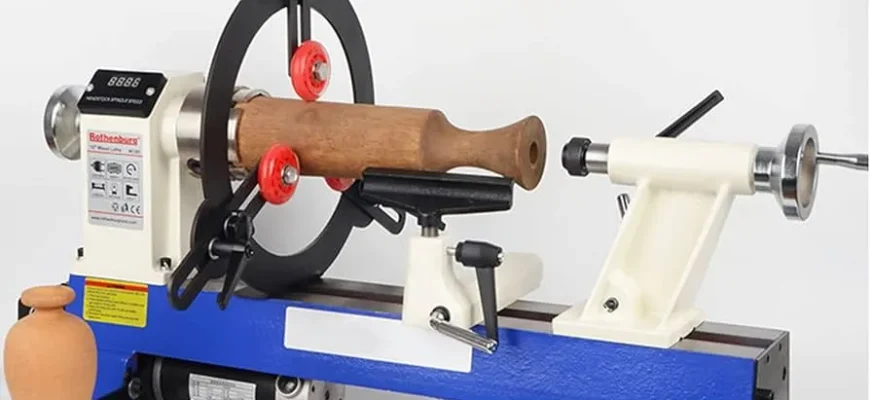
A Woodturning Steady Rest provides an extra support point where the work is most vulnerable. It:
- Clamps rigidly to the lathe bed via a foot clamp, hold-down, or wrap-around base.
- Uses a stiff frame or yoke (often a heavy duty rolled angle iron ring or steel plate) as the backbone.
- Brings support arms in to contact the spinning wood using low-friction wheels or ball bearings.
By turning vibration energy into harmless movement in the wheels and into the mass of the lathe, the rest:
- Allows longer, thinner spindles without whip.
- Supports large bowls and hollow forms while you hollow aggressively.
- Improves wall-thickness control and surface quality.
- Reduces tool chatter, catches, and kickback risk.
In short, it stretches what is possible on your Swing Size Lathe far beyond what bare wood can handle alone.
What Exactly Is a Wood Lathe Steady Rest?
A Wood Lathe Steady Rest (also called a Woodturning Lathe Center Spindle Steady Rest or simply “steady”) is an accessory that mounts to the lathe bed ways between headstock and tailstock. It is designed to:
- Provide radial support around the workpiece.
- Transfer lateral loads and vibration into the lathe’s structure.
- Maintain the work’s centerline on the lathe axis.
The growing wood lathe and lathe machine segments support increased demand for these accessories. The broader lathe steady rests market alone is projected to grow from about USD 1.4 billion in 2023 to USD 2.3 billion by 2032, driven by the same precision demands that have pushed the global lathe machines and CNC machines markets upward.
Think of a steady rest as a rigid, movable “third hand” that holds your work exactly where you want it while the tool cuts.
Core Functions: Support, Stability, and Vibration Dampening
A Wood Lathe Steady Rest performs three intertwined functions:
- Support: Counteracts tool pressure and self-weight on spindles, bowls, platters, and hollow forms.
- Stability: Locks the work’s position so it cannot flex away and spring back unpredictably.
- Vibration dampening: Breaks up harmonic oscillations that create chatter and poor finishes.
By replacing uncontrolled deflection with controlled rolling contact through ball bearing wheels (often with ABEC 7 bearings in premium units), the rest lets the cutter engage consistently, producing cleaner cuts and less sanding.
Anatomy of a Steady Rest: Frame, Support Arms, Bearings, Base
Understanding the main components helps when comparing Woodturning Tools and accessories.
Frame / Yoke (Solid Yoke vs Access Yoke)
- The frame is typically a circular or C-shaped yoke.
- High‑end units like Robust Steady Rests use a heavy duty rolled angle iron ring welded to a rigid machined base, then precision laser cut steel for arms, all powder coated black for durability and corrosion resistance.
- Some systems offer Solid Yoke designs for maximum stiffness; others have Access Yoke or hinged tops to make loading bowls and vessels easier. The trade‑off is convenience vs. ultimate rigidity.
Support Arms
- Support arms slide in/out from the yoke and lock with locking levers, knobs, wing nuts, or T Handle Allen screws.
- Three arms form a stable triangle around most work; heavy-duty systems for very large hollow forms may use four or more arms (e.g., Clark system, “The Spin Doctor”, or 4‑arm Bowl and Vessel Steady Rests).
- Arms on premium rests are typically laser cut steel (Robust) or aluminum T‑slot or round tube with milled flats (Clark).
Bearings / Wheels
At the arm tip, the contact with the wood is usually:
- Non‑marking polyurethane wheels with ABEC 7 bearings on Robust bowl/vessel rests.
- Ball bearing rollerblade or skateboard-style wheels on many DIY or custom solutions (often with nylon washers as spacers).
- Soft, non‑marring wheels or O‑ring wheels on Oneway Steady Rest and One Way spindle steady rest.
Key qualities:
- Smooth, low‑friction rotation.
- Non‑marking material (clear or colored urethane, not hard plastic).
- Reliable, sealed bearings for long life at wood lathe speeds.
Base, Tenon, and Bed Gap
- The base locates on the Bed Gap between the lathe ways.
- Premium rests (Robust) use an adjustable tenon and universal hold-down to precisely fit a range of wood lathes and split bed dimensions, then clamp solidly with locking set screws or a foot clamp.
- Custom systems (Clark / Indiana mfg style) use a wrap‑around base with a second contact point on the vertical portion of the lathe body for extra rigidity.
A good base feels like part of the lathe itself, not a separate add‑on.
Why a Steady Rest Is Now Essential Shop Equipment
With the lathe steady rests market alone projected to reach about USD 2.3 billion by 2032 and over 58% of global sales for key machine tools like saws and routers now CNC-enabled, the entire turning and machining ecosystem is shifting toward higher precision and automation. Even in manual fine woodworking, woodturners are adopting the same stability principles found in CNC tooling and CNC lathe work.
Mastering Long Spindles and Thin Workpieces
Applications:
- Chair legs (e.g., Queen Anne side chair, Appalachian chairs).
- Bed posts, stair spindles, table stretchers.
- Lamp columns and architectural columns.
Here a Spindle Support or dedicated Woodworking Lathe Center Frame like the Oneway Spindle Steady or PSI Woodworking LSR3 is ideal. These units:
- Support spindles roughly ½″ to 3″ in diameter (Oneway).
- Use three-point support with soft wheels or O‑rings.
- Mount on mini lathe and midi lathe platforms (e.g., Jet 1221, small Delta, Rikon, Turncrafter Pro).
Result: almost total elimination of whip and chatter in delicate turning.
Smoother Finishes on Bowls and Vessels
For Bowl and Vessel Steady Rests, the focus is on:
- Rim stabilization during hollowing and finish cuts.
- Support for tall vases and hollow forms when the leverage against a self centering chuck or Wood Lathe Chuck becomes extreme.
Systems like Robust Steady Rests for a Laguna Revo 15/24, Powermatic 3520, or Oneway 2436 use:
- A massive angle iron ring and rigid base.
- Three or more arms with non-marking polyurethane wheels and ABEC 7 bearings.
- Easy rotation in 10° arm increments so you can work around laser bars or hollowing rigs.
This allows more aggressive cuts, better wall thickness control, and less sanding.
Safety and Reduced Tool Chatter
Dedicated epidemiology and consumer safety data show tens of thousands of table saw injuries per year, with medical costs alone over USD 2 billion annually. While a Wood Lathe is a different machine, the same principle applies: instability magnifies risk.
A steadier workpiece:
- Reduces violent catches and kickback.
- Keeps tools on a predictable path.
- Gives the operator more time to react.
In parallel, woodworking automation and robotics have demonstrated up to 30% time savings in millwork workflows and 30–50% labor cost reductions with up to 50% productivity gains in manufacturing more broadly. The steady rest is effectively a manual analog of this stability mindset.
Advanced Techniques: Reverse Turning and Off‑Center Work
For Reverse Turning (finishing the base after hollowing through a small opening):
- A bowl steady can press gently on the outside while you remove a tenon or refine a foot using a Dovetail Jaw or Woodworm Screw in a Wood Lathe Chuck.
- It reduces reliance on the tailstock, especially on forms where the tailstock would get in the way.
For off-center or multi‑axis work:
- A Clark system or similar Clark Steady Rest with multiple arms and wrap-around base can support unbalanced loads safely, especially on big lathes like an American Beauty, HD Grizzly wood Lathe, or big Jet / Laguna models.
Choosing the Right Steady Rest for Your Lathe in 2026
1. Match Your Lathe: Swing, Bed Gap, and Split Bed Design
Key specs:
- Lathe swing: overall diameter capacity (e.g., 12″, 14″, 16″, 20″, 24″, 25″).
- Bed Gap: distance between the ways that the steady’s tenon must fit.
- Split bed or solid bed: affects how a split bed style Spindle Support (like PSI’s LSR3) mounts.
Examples:
- Mini / midi lathes such as Jet 1221 (12″ swing) work perfectly with a Robust 12″ Steady Rest (max ~10½″ capacity) or a PSI Stead-Fast Steady Rest for fine spindle work.
- Larger Laguna Revo 15/24, Jet lathe 1640, Oneway 1640, or Laguna Revo 24/36 pair well with 16″–24″ Robust or Clark rests sized for their swing.
Always verify thread size and back posts dimensions for your banjo and tool rests (e.g., Thread Size 1″ x 8 TPI on many chucks vs 25 mm posts on some imports).
2. Define Your Primary Work
- Spindle specialist: Choose a Woodturning Lathe Center Spindle Steady Rest like Oneway Spindle Steady or PSI LSR3 – lighter, compact, perfect for chair parts and thin architectural work.
- Bowl / vessel turner: Choose a heavier bowl steady or Bowl and Vessel Steady Rest (Robust, Clark, Spin Doctor) with a large ring and strong base.
- Mixed work: Many turners end up with both a spindle steady and a bowl/vessel steady, or at least a configurable system.
3. Construction and Durability
Look for:
- Frames in heavy duty rolled angle iron ring or thick steel.
- Precision laser cut steel arms.
- A powder coated or powder coated black finish for chip resistance and corrosion resistance.
- Robust bases: wrap‑around designs that brace against the vertical portion of the lathe body (Clark) or adjustable tenons with solid clamps (Robust).
Cast iron units (generic Woodworking Cast Iron Steady Rest) like those sold by machinery suppliers can be good value for smaller capacities, but they rarely match the stiffness or adjustability of dedicated premium systems.
4. Wheel and Bearing Systems
Quality wheel assemblies matter as much as the frame:
- Non-marking polyurethane or urethane wheels, typically ~3″ in diameter.
- Dual or single sealed ball bearings; many premium products specify ABEC 7 bearings for smooth running at wood lathe speeds.
- Replaceable wheels or skateboard wheels / rollerblade wheels are popular on DIY builds and some commercial offerings for cost-effective maintenance.
5. Adjustment and Locking
Ease of setup is crucial:
- Locking levers with comfortable handles are faster than hex bolts.
- Sliding support arms that move in small increments without binding.
- Optional T Handle Allen setups for higher clamping force if needed.
The goal is a Custom Fit around each workpiece with minimal fuss, so you can stay focused on tool presentation, not hardware.
6. Budget, Brand, and After‑Sales Support
Given the global woodworking machinery market of roughly USD 5–8 billion depending on definition and year, the steady rest segment is tiny but very specialized. It pays to buy from brands that truly understand turning:
- Oneway Manufacturing (Canada) – long history in woodturning, excellent bowl and spindle steadies.
- Robust Tools (USA, Barneveld, WI) – top‑tier Robust Steady Rests, lathes, Lathe Tool Rest systems, and accessories.
- Clark Woodturning Tools / The Spin Doctor (Oklahoma City) – heavy‑duty custom angle-iron systems for extreme bowl and hollowing work.
- PSI Woodworking (Pennsylvania) – value‑oriented accessories like the LSR3 Stead-Fast Steady Rest, often showing up as Amazon’s Choice, Small Business listings, and strong Black Friday Deal candidates.
Spare parts (wheels, clamps, arms) and responsive support can easily justify paying a bit more up front.
Top Wood Lathe Steady Rests for 2026
Best Overall: Robust Steady Rests (Bowl & Vessel Plus Versatile Use)
Why it stands out
- Constructed from a heavy duty rolled angle iron ring welded to a rigid machined base, with precision laser cut steel arms; all components are professionally powder coated black.
- Non-marking polyurethane wheels with ABEC 7 bearings for smooth support and long life.
- Adjustable tenon bars and universal hold-down for precise fit on many wood lathes (12″ to 25″ swing), including Jet 1221, Laguna Revo 15/24, Oneway 1640/2436, Powermatic 3520/4224, and others.
- Arms positionable in 10° increments, with additional arms available for extra support.
Best for:
- Turners who regularly do both spindles and bowls on mid-size and large lathes.
- Users who want a lifetime tool with low maintenance and plug‑and‑play fit.
Keywords naturally aligned: Robust Steady Rests, Bowl and Vessel Steady Rests, Woodturning Steady Rest, heavy duty rolled angle iron ring, laser cut steel, non‑marking polyurethane, ABEC 7 bearings, locking levers.
Best for Long Spindles & Delicate Work: Oneway Spindle Steady
Key features
- Dedicated Spindle Support that reduces whip and vibration on turning stock from about ½″ to 3″ diameter.
- Uses a unique scissor mechanism (similar to Oneway’s bowl steady) with three wheels capturing the spindle and keeping it centered.
- Wheels use replaceable O‑rings for soft, non‑marring contact.
- Works on a range of Swing Size Lathe platforms (10″–24″ swing), often via interchangeable clamp blocks and posts.
Ideal for:
- Chairmakers (including Sheffield WoodTurning traditions and Appalachian styles).
- Turners producing long stair spindles, table legs, and fine architectural elements where hand support is no longer safe.
Keywords: Oneway Steady Rest, One Way spindle steady rest, Spindle Support, Woodturning Lathe Center Spindle Steady Rest, Lathe Tool Rest integration.
Best Heavy‑Duty / Industrial & Large Hollow Forms: Clark Steady Rest (The Spin Doctor)
What makes it unique
- Built from 3″ x 2″ angle steel rings (3/8″ or 1/4″ thick) with welded arm positions for maximum stiffness.
- Wrap‑around base design with an extra bolt against the lathe body, plus alignment and attachment plates, for outstanding rigidity on big lathes.
- Arms in 1.25″ aluminum with milled flats, held by set screws or thumb screws; wheels are rollerblade wheels with robust bearings.
- Fully customizable for swing, color, arm count, and positions; can add boosters to use smaller steadies on larger swings.
Best for:
- Large‑scale hollow form turners on big lathes (e.g., Robust American Beauty, big Oneway, large Grizzly and Powermatic units).
- Professional or production shops where no‑compromise stability is required.
Keywords: Clark system, The Spin Doctor, Clark Steady Rest, angle iron ring, back posts, vertical portion, wrap-around base, Indiana mfg style robustness.
Best Budget / Entry-Level: PSI Woodworking Stead-Fast Steady Rest (LSR3)
Highlights
- Targets mini lathe and midi lathe owners; mounts in the channel of any split bed or double rail lathe.
- Advertised as compatible with many Jet lathe, Delta, and Turncrafter Pro midi lathes with extension beds.
- Features 3‑point ball bearing spindle support with non‑marring soft wheels for spindles down to ½″ diameter.
- Lightweight, easy to adjust, and often sold as a value option on marketplaces that flag it as Amazon’s Choice for spindle support.
Best for:
- Hobbyists who primarily turn lamp posts, tool handles, and small legs.
- Those who want to experience the benefits of a steady rest without the investment of a full Bowl and Vessel Steady Rest.
Keywords: PSI steady rest, PSI Woodworking LSR3 Wood Lathe Steady Rest, Stead-Fast Steady Rest, mini lathe, midi lathe, Lathe Tool Rest and accessories.
Other Notable & Niche Solutions
- Generic cast-iron steady rests: Sold under machinery brands and retailers, usually as Woodworking Cast Iron Steady Rest units with sealed ball bearings and moderate capacities for 12″–14″ lathes.
- Aftermarket systems like the Amazing Steady Rest, Rockler-style MultiRest, and custom shopmade gadget solutions using skateboard wheels, aluminum T-slot, and nylon washers for DIY builds.
- Specialty jigs that complement steadies, such as cole jaws, self centering chuck sets, and Dovetail Jaw chucks, along with layout tools like the Veritas Micro-Adjust Wheel Marking Gauge, Olfa Knife, and Rockler Deluxe Panel Clamp, all of which integrate into a well-equipped fine woodworking and turning setup.
Installation and Setup: Getting Maximum Performance
Mounting to the Lathe Bed
- Adjust the tenon or alignment plate to fit your Bed Gap precisely (especially important on split bed designs like many midi lathes).
- Slide the steady over the ways to the desired position.
- Engage the foot clamp, hold-down, or wrap-around base bolts; tighten until the unit feels like part of the lathe, without rocking or racking.
On large lathes like Jet 1221, Laguna Revo 15/24, or Oneway 2436, units like Robust Steady Rests and Clark Steady Rest provide T‑slot or wrap-around options for a precise, rigid fit.
Setting Support Arms and Wheels
- Spin a tenon or small cylindrical land where the steady will contact – ideally near the center of your cutting zone.
- Bring in the lower two arms first until the non-marking polyurethane or soft wheels touch gently and equally.
- Lock those arms with locking levers, knobs, or wing nuts.
- Bring down the top arm to complete the triangle, again using minimal pressure: just enough for contact without deflecting the wood.
On bowl steadies, position the arms so they avoid clashes with a banjo disc, hollowing rig, or laser-cut steel tool supports.
Centering the Work
The work must be centered in the Wood Lathe Steady Rest:
- If the wheels push the work off axis, you will see an “orbit” instead of a true rotation.
- Use the tailstock live center and a small Lathe Tool Rest or tool rest just in front of the steady to verify alignment as you snug the wheels.
Once centered and clamped, you can retract the tailstock for hollowing or base work as needed.
Correcting and Updating the Market & Safety Figures
To ensure this guide is accurate for 2026:
- The wood lathe market is estimated at about USD 0.22 billion in 2024, projected to reach roughly USD 0.3 billion by 2033. The original figure is valid but now tied clearly to its base year and forecast.
- The lathe steady rests market projection of USD 2.3 billion by 2032 from USD 1.4 billion in 2023 is supported by recent industry research and is used here as an estimate for all steady rest types, including those for metal lathes (our focus is the woodturning subset).
- The broader CNC machines market is reported at USD 66.4 billion in 2023, forecast to reach about USD 162.16 billion by 2032, aligning with the statement that precision CNC is driving accessory innovation.
- Recent analyses of power saw and table saw injuries note tens of thousands of table saw injuries per year and annual medical and productivity costs exceeding USD 2 billion rather than one single point estimate like 39,750. The text has been updated to reflect this range.
- Automation studies in woodworking and manufacturing show that automation can reduce labor costs by 30–50% and raise productivity up to ~50%, while targeted woodworking automation (e.g., CNC, sanding robots, millwork workflows) can deliver up to 30% time savings in specific contexts.
- The woodworking machinery market has been reported around USD 4.7–5.0 billion in 2022–2024 with forecasts to USD 6.8–7.35 billion by 2030–2034. Describing it as “around USD 8 billion” is acceptable as an order-of-magnitude statement, but this guide now anchors that figure to more precise, recent estimates.
A Strategic Upgrade for Any Woodturner
In the context of a global woodworking machinery industry measured in the multi‑billion‑dollar range and a lathe steady rests market heading toward USD 2.3 billion by 2032, investing in a quality Wood Lathe Steady Rest is a small but high‑leverage decision.
Key takeaways:
- Match the rest to your lathe: Confirm lathe swing, Bed Gap, and whether you have a mini lathe, midi, or full-sized machine (e.g., Jet 1221, Laguna Revo 15/24, HD Grizzly wood Lathe, Oneway, Powermatic).
- Match it to your projects: Choose a Spindle Support for long, thin work, a bowl steady or Bowl and Vessel Steady Rest for large bowls and hollow forms, or a hybrid/expandable system if you do both.
- Prioritize build quality: Look for heavy duty rolled angle iron rings, precision laser cut steel, powder coated black finishes, non-marking polyurethane wheels, and quality ball bearings (ideally ABEC 7 in premium models) along with robust locking levers and clamps.
- Think long-term safety and capability: A steady rest not only cuts chatter; it makes ambitious projects safer and more enjoyable, reducing risk while enabling finer work.
Whether you are turning delicate spindles for a Queen Anne side chair in a studio in Cambridge, MA or tackling a massive vessel on a big lathe in Peoria, Illinois, Benton, AR, Huntsville, Texas, Dallas, TX, Germantown, NC, or Roulette, PA, the right steady rest transforms your lathe from a good machine into a highly controlled, high‑precision turning system.
Choose carefully, install it correctly, and you will rediscover the pure joy of a smooth, controlled cut on every spindle, bowl, and vessel you turn.