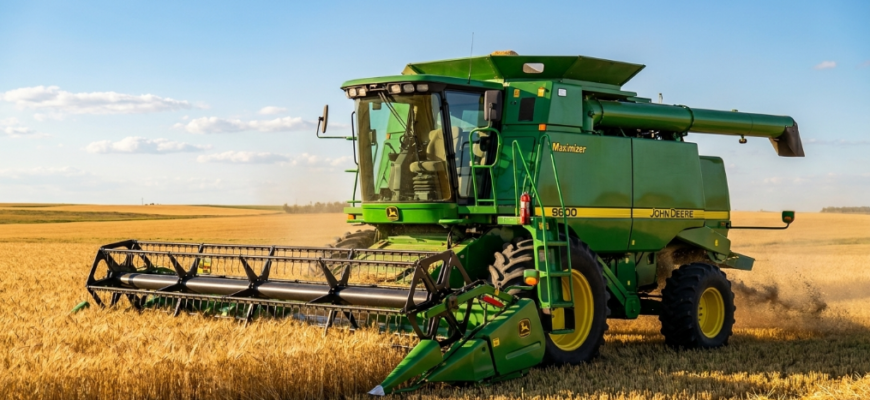
The John Deere 9600 is a conventional walker “Maximizer” series combine built from 1989 through 1997 at John Deere’s Harvester Works in East Moline, Illinois. It was the largest model in the original 9000-series line, above the 9400 and 9500, and targeted mid‑to‑large grain farms needing high capacity without the complexity of a rotary machine.
Even in 2026, clean John Deere 9600 combines sell regularly on dealer lots and online auctions, typically ranging from roughly 7,500 to around 30,000 USD depending on hours, condition, and included headers. Owners consistently describe the 9600 as a durable, straightforward machine with inexpensive parts and relatively easy repairs, provided wear items have been kept up.
This report is structured as a decision engine for buyers evaluating a used John Deere 9600: it covers specifications, realistic pricing, buying checklists, manuals, maintenance realities, model comparisons, and FAQs.
Is a John Deere 9600 Still Worth Buying in 2026?
For buyers who understand what to inspect—engine, walkers, cylinder, augers, hydraulics, and electronics—a well‑sorted 9600 can still be a money‑making harvest machine or a reliable backup in 2026. For those who treat it like a nearly-new combine, the hidden cost is deferred maintenance: worn concaves, tired walker bearings, thin auger flighting, and potential engine repairs that can run into tens of thousands of dollars.
What the John Deere 9600 Is, Specs, Price & Best Use Cases
The John Deere 9600 is a self‑propelled, conventional straw‑walker combine harvester in the Maximizer 9000 series, featuring a center cab, rear-mounted engine, and walker‑based separation system. It was produced from 1989 to 1997 and positioned as the high‑capacity model above the 9500 and 9400.
Key technical specs include a 7.6 L six‑cylinder turbocharged diesel engine in the 6076 family with roughly 250–260 hp depending on year and configuration, a 240‑bushel grain tank, a 140‑gallon diesel fuel tank, a 64.5‑inch wide cylinder, and a hydrostatic three‑speed transmission driving five straw walkers.
Real‑world 2023–2025 sale data indicates most working John Deere 9600 combines sell between about 7,500 and 25,000 USD, with exceptionally clean, later‑model machines or those including good headers occasionally bringing around 25,000–30,000 USD. This makes the 9600 most attractive for budget‑conscious grain farms, custom operators adding a backup machine, and growers in regions where dealer support and used parts are plentiful.
Full Specifications (Scannable Table)
The table below summarizes core John Deere 9600 specifications relevant for buyers comparing capacity and capability.
Because the 9600 shares many components with 9400/9500 and later 10‑series machines, a deep used‑parts ecosystem exists for engine, driveline, straw walker, and cleaning components.
Real Sale Prices & 2026 Market Breakdown
How Much Does a John Deere 9600 Cost Today?
Recent auction records from a major online auction platform show John Deere 9600 combines selling between about 7,590 and 29,700 USD from late 2023 through early 2025, with most transactions clustering in the 8,000–25,000 USD range. Examples include closed contract prices of roughly 7,590, 8,470, 8,910, 10,010, 17,050, 18,150, 25,300, and 29,700 USD depending on year, hours, and condition.
Dealer and classified listings in Canada and the United States commonly advertise 9600s in the equivalent range of roughly 11,000–26,000 USD, with some clean, late‑model machines priced around 35,900 CAD (≈ 25,900 USD) and others marked “parts only” at lower price points.
Farmer forum contributors note that “lot of unknown, 15–55k” is seen across classifieds, while also commenting that a 9600 “better be dang nice to be worth over 25k,” aligning with auction bands where truly exceptional machines bring a premium.
Price Tiers: Low‑End, Mid‑Range, High‑End
Low‑end (non‑running / parts / heavy wear)
- Includes combines sold as “parts only,” machines with major engine or driveline issues, or very high‑hour units where most wear items are due again.
- Real auction data shows several 9600s closing around 7,500–10,000 USD, which is consistent with buyers paying salvage or fixer‑upper money rather than turnkey harvest prices.
- Some owners report engine replacements on older Deere combines costing close to 30,000 USD, so a cheap base machine can quickly become expensive if a major failure occurs soon after purchase.
Mid‑range (working field machines)
- Typical working 9600s with roughly 4,000–6,000 engine hours and 3,000–4,500 separator hours, with average cosmetic wear but functional systems, often sell between about 12,000 and 20,000 USD depending on headers and recent work.
- Farmer feedback suggests that around 4,000 engine hours many components start needing replacement (walker bearings, augers, chains, sieves, concaves, chopper), while by 6,000 hours “everything has been rebuilt,” so a mid‑range price only makes sense if critical rebuilds have already been done.
High‑end (refurbished / low‑hour / late‑model)
- Exceptional late‑production units (1995–1997) with lower hours, strong maintenance records, and high‑value headers can sell around 20,000–30,000 USD, with a few documented auction contracts in the mid‑20,000s and upper‑20,000s.
- Dealer listings around 35,900 CAD (≈ 25,900 USD) for clean machines and farmer comments that “it better be dang nice” to justify 25,000+ USD support this high‑end range.
Realistic 2026 Price Expectations
Considering 2023–2025 auction and dealer data plus inflation and aging, a realistic 2026 expectation for most buyers is:
- Project/parts machines: 5,000–10,000 USD equivalent (or less if incomplete or severely damaged).
- Average working 9600 with high hours: roughly 12,000–18,000 USD, assuming it can go to the field with only minor repairs.
- Well‑sorted, later‑model units with good headers and recent work: roughly 18,000–25,000+ USD, with only the very best examples justifying prices approaching 30,000 USD or slightly above.
Compared with new flagship combines that often cost 500,000–900,000 USD in 2024–2025, the 9600’s capital cost is tiny, but buyers must plan for ongoing repairs and downtime associated with a 30‑plus‑year‑old machine.
What Sellers Don’t Tell You
- Hour meters can be misleading: some 9600s had tachs upgraded or replaced with later dual‑display units, and in those cases the hour count may have restarted, meaning the apparent hours may be lower than actual.
- Classified ads rarely list all recent rebuilds in detail; many owners report that by roughly 6,000 engine hours walkers, concaves, augers, chains, sieves, and choppers have been replaced at least once, so a “freshly rebuilt” machine might simply be at the point where the next rebuild cycle is approaching.
- Sellers may not emphasize borderline issues like sloppy walker cranks, out‑of‑balance choppers, or weak hydraulics, all of which can lead to costly downtime if not caught before purchase.
Should You Buy a John Deere 9600? Pros & Cons
Key Advantages (Pros)
- Proven reliability and simple mechanics: Long‑time owners and AgTalk contributors describe the 9600 as “very reliable” and “pretty bullet proof” as long as routine wear items are kept up, and note that “everything on a 9600 is inexpensive and doesn’t require a tech to fix much.”
- High capacity for the money: With a 240‑bushel grain tank, five walkers, and a wide cylinder, the 9600 offers higher throughput than 9400/9500 machines while costing far less than more modern combines.
- Strong parts support: The model shares many components with 9400/9500 and later STS machines, and multiple aftermarket suppliers stock straw walker components, concaves, hydraulic parts, and other wear pieces.
- Good small‑grain performance: As a conventional walker machine with generous separating area and cleaning shoe, the 9600 performs especially well in wheat and other small grains when set correctly.
Key Disadvantages (Cons)
- Age‑related failures: Many 9600s now have 4,000–8,000+ hours, and owners report that around 4,000 hours “a lot of things start to need replaced,” while by 6,000 hours nearly everything has been rebuilt at least once. Buyers must budget for ongoing replacement of bearings, chains, augers, and sheet metal.
- Less fuel‑ and labor‑efficient than modern combines: Newer flagship combines can harvest more acres per hour with better fuel efficiency per ton, and high‑end 2024–2025 models command 300,000–900,000 USD but reduce per‑acre operating cost on very large farms. For small‑to‑mid‑size farms, however, the 9600’s low capital cost can outweigh efficiency disadvantages.
- Soybean and tough‑crop limitations: Farmers note that as a conventional walker machine, the 9600 is not as strong in soybeans—particularly with dry beans or green pods—compared with later rotor machines, and may crack more beans if not carefully set.
- Comfort and electronics: Compared with late‑model combines, the 9600 lacks modern cab comfort, precision electronics, and advanced yield monitoring found on 21st‑century machines; retrofits are possible but add cost.
Who the 9600 Makes Sense For
- Farms wanting 240‑bushel capacity and conventional separation at low purchase price.
- Budget‑focused buyers comfortable doing their own repairs and preseason inspections.
- Operations needing a backup combine to protect against downtime on newer primary machines.
- Growers in regions with strong Deere dealer presence and readily available salvage or aftermarket parts.
High‑Conversion Buying Checklist: “Before You Buy, Check This”
This checklist distills common advice from experienced owners and mechanics so a pre‑purchase inspection reveals the true condition of a used John Deere 9600.
1. Engine & Hours
- Verify engine hours: Ask for documentation on tach replacement; if a later 10‑series style tach was installed, confirm whether hours restarted and compare to service records.
- Cold start behavior: Start from cold and watch for excessive white or blue smoke, hard starting, or abnormal engine noises, which may indicate injector, turbo, or internal wear on the 7.6 L engine.
- Oil leaks & blow‑by: Check crankcase breather for heavy blow‑by and look around the oil pan, front and rear main seals, and valve cover for significant leaks; major engine repairs have been reported to cost close to 30,000 USD on similar Deere combines.
2. Cylinder, Concaves & Threshing Components
- Inspect rasp bars for rounding and uneven wear; worn bars reduce threshing efficiency and increase losses.
- Check concaves for cracks, thin bars, and uneven wear (center section often wears most on walker combines); badly worn concaves require replacement to maintain capacity and grain quality.
- Verify cylinder clearance adjustment works smoothly and that there is no contact between rasp bars and concaves when set to spec.
3. Straw Walkers, Cranks & Bearings
- Lift each straw walker by hand (from inside the rear access) and feel for excessive vertical play or slop in cranks and bearings, which indicates wear that can lead to failure.
- Inspect wooden or aluminum walker blocks (depending on updates) for cracks, looseness, or signs of heat; failed walker bearings can cause severe damage.
- Check straw walker frames for cracks or repairs, especially near bearing housings.
4. Cleaning System: Sieves, Chaffer & Fans
- Inspect chaffer and sieve frames for cracks, broken fingers, and sloppy linkages; replacements are common around or after 4,000 hours.
- Inspect fan housing and blades for cracks or imbalance; excessive vibration during a test run may signal impending failure.
- Confirm adjustment linkages move freely and that sieve and chaffer opening indicators respond correctly.
5. Augers, Elevators & Grain Handling
- Inspect clean‑grain and return elevators for thin housings, worn chains, and broken paddles.
- Examine unloading auger and cross‑augers in the tank; sharp leading edges and thin flighting indicate nearing end of life and can be expensive to replace.
- Engage the unloading system under load if possible to listen for vibration or grinding.
6. Feederhouse & Header Interface
- Check feederhouse floor for wear holes and thin spots; patching or re‑flooring may be imminent on high‑hour machines.
- Inspect feeder chain for stretch, broken slats, or uneven wear.
- If equipped with contour‑master, verify full range of motion and check tilt cylinder pins and bushings for play.
7. Hydraulics & Hydrostatic Drive
- Look for leaks around hydraulic pumps, valves, steering components, and hydrostatic drive; aging hoses and seals are common failure points.
- During a test drive, verify smooth ground‑speed control, no surging, and full power in each range of the hydrostatic transmission.
- Check steering and braking responses for sluggishness or noise.
8. Electronics & Monitoring
- Test warning lights, gauges, and buzzer systems, including engine oil pressure, temperature, grain loss, and shaft monitors.
- Confirm feederhouse, unloading, and chopper engagement interlocks function correctly; electrical issues can be time‑consuming to trace.
- Inspect harnesses for prior repairs, splices, and rodent damage.
9. Documentation & Maintenance History
- Request service records and any “Greenlight” or dealer multi‑point inspections; one AgTalk contributor recommended a comprehensive inspection as it can pay for itself in prevented downtime.
- Ask specifically about last replacement dates for walkers, concaves, sieves, and augers; this tells you where you are in the major‑component lifecycle.
- Verify serial number and model year against manuals and any recalls or product improvement programs.
Manuals & Documentation: What You Need and Why
Main Types of John Deere 9600 Manuals
- Operator’s Manual (OMH161694 and similar): Official John Deere operator manuals for the 9400/9500/9600 covers machine operation, daily service points, lubrication charts, safety, basic adjustments, and operating tips; current PDF versions run around 390+ pages in English, with Russian and other language versions also available.
- Technical/Repair Manual (TM1401): The John Deere 9400, 9500 and 9600 Combines Repair Technical Manual (TM1401) provides full diagnostic and repair procedures for engine, power train, electrical, hydraulics, and separator systems, with over 1,200 pages of detailed service steps.
- Parts Catalog (PC2181 and related): The 9600 Maximizer Combine parts catalog lists every component, exploded diagrams, and part numbers for ordering from Deere or aftermarket suppliers, often available as large PDF downloads.
These manuals are distributed through John Deere, dealer networks, and third‑party manual sellers; many are available as instant‑download PDFs.
Why Manuals Matter Before You Buy
- Reviewing the operator and technical manuals in advance gives a clear picture of maintenance intervals, lubrication requirements, and adjustment procedures, helping buyers estimate the real time and cost to keep a 9600 field‑ready.
- Technical manuals show how involved specific repairs are (e.g., replacing walker bearings or rebuilding the hydrostatic system), allowing buyers to judge whether they can reasonably perform work themselves or will need dealer assistance.
- The parts catalog is invaluable for pricing wear components such as walker bearings, concaves, sieves, cylinder bars, and hydraulic components, and for confirming that aftermarket parts advertised online match correct OEM part numbers.
Maintenance & Common Problems: Ownership Reality
Typical Wear and Failure Points
Owner and mechanic discussions highlight a series of predictable wear points on higher‑hour 9600 combines:
- Walker bearings and blocks: Wooden or aluminum straw walker blocks and associated bearings wear and can fail catastrophically if not replaced in time.
- Concaves and rasp bars: Expect concave and cylinder bar replacement one or more times over the life of the machine, particularly after 4,000+ separator hours.
- Augers and chains: Grain tank, unloading, and elevator augers thin over time, while clean‑grain and return chains stretch and need replacement.
- Sieves and chaffer: Cracked frame members, worn bushings, and broken fingers are common, with some owners reporting complete replacements on high‑hour machines.
- Chopper and straw handling: Out‑of‑balance or worn choppers can cause vibration and cracking; straw spreaders and chopper knives are frequent wear items.
- Hydraulic leaks and hose aging: Age‑related hose and seal failure is common on combines this old, especially if hoses are original.
Engine and Major Component Risks
- The 7.6 L Deere engines used in 9600 combines are generally regarded as strong, but forum posts document cases where neighbors have spent close to 30,000 USD for major engine replacement on older Deere combines, underscoring the risk of running a high‑hour machine without close monitoring.
- Tach replacements and incomplete service history can hide true hours; buyers should assume that any suspiciously low reading may not reflect total run time.
Preventive Maintenance Priorities
- Follow filter and fluid change intervals from Deere’s official capacity and service‑interval charts for the 9400/9500/9600, including engine oil, hydraulic/hydrostatic, and gearcase filters.
- Conduct preseason “Greenlight”-style inspections (either through a dealer program or self‑performed using technical manual checklists) to catch walker, concave, sieve, bearing, and belt issues before harvest.
- Keep concaves, rasp bars, and sieves in good condition and correctly adjusted, as poor threshing and cleaning settings are a major source of lost grain on walker combines.
John Deere 9600 vs 9500 vs 9400
The 9600 sits at the top of the original 9000 series, above the 9500 mid‑range and the smaller 9400. Big Tractor Power and other sources outline clear differences in capacity and power among these models.
Core Model Comparison
How to Choose Among 9400, 9500, and 9600
- Choose a 9400 if acreage is modest and there is a strong price advantage versus a 9500/9600, but note that capacity is significantly lower due to smaller tank and fewer walkers.
- Choose a 9500 for a balance of capacity and cost when a full 9600 is not needed, especially on mixed crop farms where a slightly sma*Concaves, rasp bars, and elevator chains**: Concave wear, rounded rasp bars, and stretched grain elevator chains are typical issues after thousands of separator hours and directly affect threshing quality and losses.
- Sieves, chaffer, and fan components: The cleaning system is subject to cracking, bending, and bearing wear, especially if the machine has been run in rough conditions or with chronic imbalance.
- Hydraulic leaks and fittings: A wide range of hydraulic components for the 9600 is sold on aftermarket sites, reflecting routine leak repair and replacement of hoses, valves, and fittings.
- Electrical gremlins: Issues such as faulty oil‑pressure sending units, parking brake switches, and other simple sensors appear in owner discussions, although these are generally inexpensive fixes.
Repair Costs and Budgeting
Because the 9600 uses relatively straightforward mechanical systems, individual wear‑part replacements—such as walker bearings, straw walkers, concaves, or hydraulic components—are usually affordable in parts cost, especially when sourced from aftermarket suppliers. However, labor can be significant if done by a dealer, and neglecting small issues can lead to much larger failures; for instance, failure to address engine problems early can result in full engine replacement costs that some owners report approaching 30,000 USD on comparable Deere combines. Buyers are therefore advised to budget several thousand dollars above purchase price for catch‑up maintenance during the first season with a used 9600.
Preventive Maintenance Priorities
Preventive measures that owners and service literature emphasize include:
- Strictly following lubrication and filter intervals described in the operator’s and filter‑overview manuals, especially for engine oil, hydraulic, and hydrostatic systems.
- Regularly inspecting and adjusting concave clearance, cylinder speed, and sieve settings to avoid excessive grain loss or overloading; guidance from straw‑walker setup resources stresses keeping concaves and rasp bars in good condition and correctly leveled.
- Conducting pre‑season inspections of walkers, bearings, chopper components, and elevator chains to catch problems before harvest begins rather than during critical field windows.
With disciplined preventive maintenance, many owners report running 9600‑series combines beyond 6,000 engine hours and 9,000 hours on related 10‑series machines, demonstrating the platform’s durability when cared for.
John Deere 9600 vs. 9500 vs. 9400
Side‑by‑Side Specifications
Big Tractor Power and related technical coverage of the Maximizer series clearly position the 9600 as the largest of the three original 9000 combines, with the 9400 and 9500 as lower‑capacity siblings. Key comparative specs include:
Exact horsepower and tank capacities can vary slightly across sources and model‑year updates, but the pattern is consistent: moving from 9400 to 9600 increases power, grain tank size, and walker capacity.
Ideal Use Cases by Model
- 9400: Best suited to smaller acreages, lighter crops, or farms that prioritize lower upfront cost and are comfortable with reduced capacity; its smaller grain tank and lower power limit throughput compared with the 9600.
- 9500: The general‑purpose workhorse in the line, suitable for a broad range of crops on mid‑sized farms; it shares many components with the 9600 but with less power and capacity.
- 9600: The right choice where harvest windows are tight and there is enough crop volume to use the extra capacity, or where a farm wants a single conventional combine to handle its entire acreage.
For buyers who can find a well‑maintained 9600 at similar pricing to a 9500, many farmers suggest choosing the larger 9600 for its additional power and throughput, assuming transport and header size are compatible with the operation.
Who Should Buy a John Deere 9600 in 2026?
Small and Mid‑Sized Grain Farms
Operations harvesting a few hundred to a couple of thousand acres of wheat, barley, oats, or corn per year can often justify a 9600 as their primary combine, especially when upgrading from much older models. The combination of a 240‑bushel grain tank, solid power, and conventional simplicity gives a good balance of capacity and affordability for farms that cannot justify the cost of late‑model rotaries.
Budget‑Conscious Buyers and Start‑Up Operations
Buyers entering grain farming or expanding from custom‑hiring into owning equipment can use a 9600 to access mid‑sized combine capacity without taking on heavy long‑term debt associated with new machines. Provided the machine is inspected carefully and purchased at realistic prices, the lower capital outlay can offset higher operating costs from fuel and maintenance relative to newer equipment.
Owners Needing a Backup or Secondary Machine
For farms that already run a newer combine, a 9600 can serve as an inexpensive backup to protect against downtime during critical harvest windows. Many owners note that they have continued to run high‑hour 9600 and 9610 machines reliably as second combines with modest investment in ongoing maintenance.
FAQ
How much does a John Deere 9600 cost?
In recent 2023–2025 auction results and dealer listings, working John Deere 9600 combines have commonly sold from roughly 7,500–18,000 USD for high‑hour or average‑condition machines and up to about 25,000–30,000 USD for clean, later‑year units with good maintenance and headers. Non‑running or parts‑only machines can sell for under 10,000 USD, while truly exceptional examples with documented low hours may occasionally bring prices near or just above 30,000 USD.
What engine does the John Deere 9600 have?
The John Deere 9600 is powered by a 7.6 L six‑cylinder turbo‑diesel engine, commonly the John Deere 6076 series, with rated output in the 250–260 hp range depending on model year and calibration. This inline‑six engine is known for durability and straightforward service, making it a key factor in the 9600’s reputation for long‑term reliability in grain‑harvesting operations.
What years was the John Deere 9600 made?
The John Deere 9600 Maximizer combine was produced from 1989 through 1997 at John Deere’s Harvester Works in East Moline, Illinois. Within this run, Deere updated the design and offered different engine and option packages, so specifics can vary by serial number and year.
Is the John Deere 9600 still worth buying in 2026?
Many grain farmers and machinery dealers still consider a well‑maintained 9600 worth buying in 2026, especially for small to mid‑sized operations that want strong capacity at a fraction of modern‑combine cost. The key is purchasing a machine with documented hours, evidence of timely maintenance, and a repair budget of several thousand dollars for wear‑part replacement; buyers who skip inspection or pay top‑end prices without proof of condition often end up paying for avoidable repairs.
How many engine hours should a used John Deere 9600 have?
There is no universal “safe” hour limit, but many 9600 owners treat around 4,000 engine hours as the point where significant wear‑part replacement (walkers, concaves, chains, sieves, chopper, etc.) becomes common, and 6,000 hours as a threshold where most major components will have been rebuilt at least once. Machines with under 4,000 documented hours and clean maintenance records are generally more attractive to buyers, but any 9600 above roughly 4,500 hours should be inspected rigorously and priced with those rebuilds in mind.
Where can I find the John Deere 9600 manual?
The official John Deere operator’s manual for the 9400/9500/9600 combines (e.g., OMH161694 and language variants) and the technical/repair manual TM1401 are available as PDFs from authorized digital‑manual sellers and third‑party technical‑manual sites. Physical copies can also be found on auction and parts‑listing platforms, and the John Deere 9600 parts catalog (such as PC2181) is available online for exploded‑view diagrams and part numbers.
What are the most common problems on a John Deere 9600?
Common issues reported by owners include worn straw walker bearings and crank assemblies, degraded concaves and rasp bars, stretched elevator chains, chaff sieves and chaffer damage, and hydraulic leaks around hoses and fittings. Electrical gremlins such as oil‑pressure sending units and parking brake switches also appear in some discussions, although these are usually low‑cost, simple fixes.
Is the John Deere 9600 better than newer rotary combines?
For raw capacity per dollar, the 9600 is often a better value for small to mid‑sized grain farms, but it is not “better” than modern rotary combines in fuel efficiency, operator comfort, automation, or integrated precision‑ag features. The 9600 wins where buyers prioritize low‑equipment cost, simple mechanics, and proven reliability; newer combines win where buyers can justify higher capital outlay in exchange for more efficiency, comfort, and data‑driven harvesting.
Can a John Deere 9600 be used on both wheat and corn?
Yes; the 9600 is widely used for both wheat and corn, typically with a 9‑ to 12‑row corn head depending on row‑spacing and tire configuration. Owners note that it handles wheat and small grains very well, but that it can be harsh on soybeans and high‑moisture corn if not carefully adjusted, so proper concave and cylinder‑speed settings are critical for minimizing grain damage.
How do I inspect a used John Deere 9600 before buying?
Key inspection steps include checking engine hours and maintenance records, starting the engine cold to watch for smoke and pressure issues, examining feederhouse wear and chain condition, inspecting cylinder and concave wear, lifting straw walkers to check for crank bearing slop, and testing hydraulic and electrical systems. A detailed pre‑buy checklist that covers engine, drivetrain, threshing, cleaning, chopper, hydraulics, and cab will help you price the machine realistically and negotiate for any needed repairs.